



The commentary around drones never ends and the challenges of killing those pesky metal birds haven’t gotten any easier. So I teamed up with my WarTalk co-host Justin Mc to talk about how to fight drones with the fundamentals. Much like last year when we teamed up to talk about what good training looks like. Justin is a retired Army Special Forces soldier working in defense tech. You should subscribe to his Substack Mind of Things.
Drones are scary. You can watch people die from them online, they can approach from any direction, and they’re cheap to produce (relatively). Our sensors tuned for exquisite threats have to adapt to the cheap stuff. Our munitions trained for single shot or small salvo engagements against similarly exquisite munitions don’t have the depth or cost per shot to justify hunting drones after the first few waves. From a technical perspective, we will get to a solution, but it will take time and a lot of trial and error to be as mature and widespread as the things we’re trying to protect. But that doesn’t mean we lay down and die or fail to consider how to adapt with what we have.
It would be intellectually and factually dishonest to say drones aren’t a significant threat that pose a serious challenge to existing American force structure and tactics. There’s an entire startup industry and prime investment effort built around solving the Counter-UxS (this article will focus on Counter-UAS for ground components) problem because of how serious the problem is for us. But in the valley of death between tech development and deployment, there has not been enough serious, consistent effort in fighting and surviving drone attacks with what we already know. Unfortunately, the focus on the tech challenge has given a lot of folks the impression that the tech answer is the only component of the counter-UAS solution. And that’s just simply not true. FPV and autonomous drones as a technology may be new, but the kind of threat that they pose (as kinetic salvos and emissions hunters from the air) is not new.
To be sure, the more exposure you have to a threat, the better you can be at training for it (so long as you survive). Unfortunately, US troops have not had the kind of exposure that Ukrainian and Russian troops have had in countering drone-based effects in every waking hour on the battlefield. American units still have a lot of training to do and waiting for technology deployment and proficiency is not the correct answer. Consider the (viral) story of a recent rotation by an American mechanized unit in Germany for how US units are both succeeding and failing to prepare for the drone fight.
What happened when the US brought in a Ukrainian FPV drone unit to fight one of their brigades in a force on force exercise? Pain first, then adaptation. During the training exercise Combined Resolve, the U.S.’s 3rd Brigade Combat Team, 1st Cavalry Division took on a combined U.S. and Ukrainian red team and, as the WSJ’s headline dramatically states, “U.S and Ukrainian Forces Went Head-to-Head in an Exercise. Ukraine’s Drones Won.”
If we had headlines written about every time we got beat by red forces in a field op, well, there’d be a lot of headlines. But that’s how it’s supposed to work. You learn from pain, repetition, and failure. It happens even in regular training rotations. It might look better to win all the time, but then we’d just be lying to ourselves.
In these exercises the red force (pretend enemy) typically has advantage through terrain knowledge, training, etc. This is not trying to paint a rosy view and say, “the U.S. is not doing that bad, they had a hard hand.” It’s supposed to be hard. We acknowledge there are inherent advantages the red force had, and assessing enemy advantages and adjusting for them is something that every good commander should be able to do when they look at the battlefield. Of course, this requires adherence to Sun Tzu’s maxim, know the enemy and know yourself, which commanders to this day struggle with, or else it would not be a maxim.
Where we, the authors, struggled with this story was actually the retelling of the experience by one of 3rd BDE’s company commanders: Allan Watson, in Task and Purpose. To be sure, what you’re about to read isn’t meant to single out CPT Watson. As both of us know countless officers and NCOs who could and very much have made the same mistakes. We suspect this is a force-wide issue. But we want to use his case study, since he presented it in T&P, for how we can help get troops ready for the drone fight faster (which is the whole point of sharing lessons learned, like CPT Watson’s.)
In his article, CPT Watson lays out how his unit learned, how they experimented, and why the training rotation was positive. And sure, that’s one way to view the story, but what we saw when we read the retelling of the rotation was a failure to apply the basics to the modern fight. Because, again, drones are new and sometimes we forget that the core tenets of warfare still apply as technology evolves. So how could 1st CAV have avoided a lot of that early pain? How can all units train for the counter-uas fight and survive the “hunting” on the battlefield as Chairman Caine recently put it?
Open your Ranger Handbook.
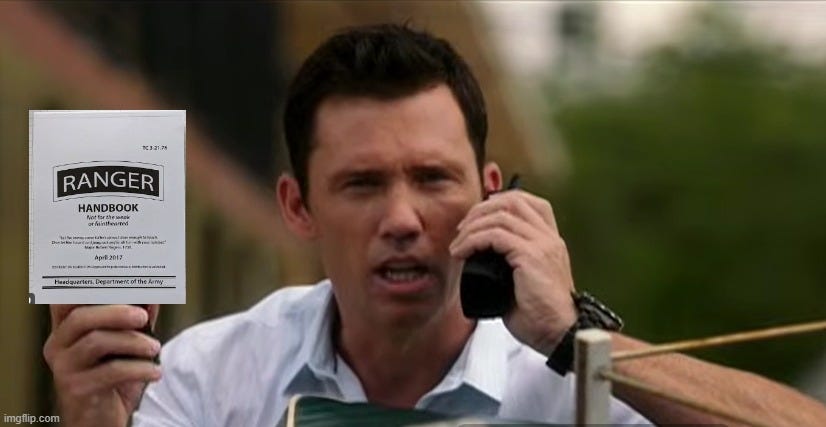
The Ranger Handbook is the infantryman and small unit leader’s bible. Every infantryman picks it up in basic and is expected to learn it and then pass on those learnings as they grow into NCOs. Every Army officer is handed one in OCS or ROTC. It’s not a bespoke or rare white paper of lessons learned from a battlefield far away. It’s the Army’s 101 and it is a product that good leaders not only learn but keep with them, because when you’re tired and hungry, you can lean on your Ranger Handbook. Between the two of us, our 2017 edition doesn’t have a single mention of drones. And yet it has a lot that can be applied to the drone fight.
Some of the “learning” Allan’s company did, per his article. was building confidence in spreading out, using terrain, and applying cover and concealment. These are not lessons that we should be learning at a joint training center. These are fundamentals. They are in the Ranger Handbook and should be tattooed on the mind of every Soldier at the Brigade and below level. These are things covered at your very first team STX lanes as you work up in the months prior to a rotation like the one in this story.
“To survive on the battlefield, stealth, dispersion, and security is enforced in all tactical movements. The leader is skilled in all movement techniques.”
Consider Chapter 6 of the 2017 version of The Ranger Handbook: Movement. It lays out some basic rules and shapes, but the more important information is in the movement techniques. When contact is expected your move is bounding overwatch, which is slow, with the highest security. Dismounted soldiers should be 20 meters apart, at a minimum, further if they are in more open terrain, this dispersion keeps soldiers safe by preventing one weapon from taking out multiple soldiers. (Note: dispersion rates are determined by geography, visibility, and friendly and enemy weapons systems.) Dispersion, however, feels evolutionarily unsafe. This is what Allan is referencing when he said his soldiers had to build confidence before they could spread out. It’s a frequent problem any mounted or dismounted leader has had to train against. Clumping, being able to talk to your buddy, and being able to see everyone feels more secure, but that security is an illusion. These are basics for movement.

Allan claimed his unit, in a battle simulation, was learning something The Ranger Handbook calls “Fundamental.” When we say fundamental, we mean things that they should be learning in individual and small unit level training, not during a Brigade operation.
“Patrols use stealth, and cover and concealment of the terrain to its maximum advantage.”
This means the patrols need to move along routes that the enemy does not expect them to move along. You patrol far enough apart that the engagement of any team does not constitute the engagement of the entire patrol. These are the basics. Basics save lives and conserve combat power. But, only if they are used and become second nature to every soldier in the organization.
A complaint some could make is “The Ranger Handbook is just for dismounted operations. It does not account for the unique aspects of mechanized operations.” This is wrong. The book does in fact cover mounted operations but the core issue is that mounted maneuver and dismounted maneuver differ only by scale, but the basics, dispersion, sight, travel order, and the need for rehearsals still exist. Allan’s company was learning this in battle by his admission. They did not practice the 1/3rds 2/3rds rule. The rule is you should spend 2/3rds of your time rehearsing. Strong and consistent rehearsals are what separate “equipped” soldiers from “trained” soldiers. We hardly think Watson’s unit is unique here. In fact, if you polled all US combined arms companies, you’d find a very inconsistent approach to counter-UxS training. Some of that will be because of experimentation culture, but a lot of that will be because the right guidance and lessons aren’t being applied and shared. Waiting for tech and handwaving training can’t be the answer. Drones or RPGs, tanks or hypersonic missiles inbound, the fundamentals still count for keeping you alive.
On the subject of armored warfare, Allen’s soldiers also learned that tanks are not perfectly secure nor perfect security for infantry. Tanks aren’t in the Handbook, but in a combined arms formation tanks perform the same basic function in relation to infantry that heavy weapons like machine guns perform for rifle squads. They are your heavy but your heavy isn’t invincible and the racket that gun kicks off brings a lot of firepower AND attention. That should be a lesson that every armored soldier has branded on them. It is a lesson we saw Russia learn in real time during the opening days of the invasion of Ukraine. How you die might change as technology evolves, but the reasons you die (lack of cover, concealment, bravado, bad luck, etc) remain the same.
Staying on this topic for a second, armor and infantry (including infantry fighting vehicles like the Bradley) operate symbiotically. Armor is your heavy. They own your strong points and bring the hate against enemy strong points and armor. Weapons squads (like those in your Ranger Handbook and formations) are your heavies when dismounted. That heavy firepower keeps your infantry alive, but your infantry have to help keep your armor alive lest your unit be systematically picked off by hunter/killer teams. Drones are an evolution of hunter/killer RPG teams. Those target priority lists you work up in training and gunnery, the enemy does those too. Working drones into the mix as an effective anti-dismount and anti-armor weapon is simply the next evolution.
On the topic of artillery…drones work both for hunting you direct via one-way attack (OWA) strikes (also known as suicide strikes) or by spotting for the real heavy hitters from beyond the horizon. Make UAS spotters your HVT like you would an enemy FIST (artillery spotter) position. Practice dispersal and reconsolidation SOPs for incoming drone strikes. That’s in the Ranger Handbook too under “React to Indirect Fire” and “React to Ambush.”
The Basics
Military language is filled with slogans, aphorism, maxims, and proverbs. Most of them start and end with profanity. Some of the most common you hear are things like “slow is smooth and smooth is fast,” and ”prior planning prevents piss poor performance.” You will also hear, “you can’t miss fast enough.” All three of these apply to every unit in the military.
The three ideas are interconnected. You will be able to be calmer, and move more smoothly, when you have planned and rehearsed. You shake out the friction. That smoothness translates to more time to make decisions which lowers the change of a missed target, a missed task, or lost objective. The ability to be calm comes, in part, from mastering the basics. This lesson forms perfectly in two places in the handbook, “Battle Drills” and “Principles of Patrolling.”
The Ranger Handbook chapter on battle drills might as well be called “Reaction time and faster decisions” because that is why battle drills exist. Battle drills are what they sound like: things you practice over and over so they become automatic. These are things everyone knows how to execute on command or because you’ve just been ambushed. They are required for your survival. The first battle drill in the book is react to contact. It is prescriptive. The book tells soldiers and leaders what they should do from the moment they see the enemy. Even with this script, it is still hard to do well because the enemy and terrain get a vote.
The same is true of the principles of patrolling: Planning, Reconnaissance, Security, Control, and Common Sense. These sound simple but, like Carl said,
“Everything is very simple in war, but the simplest thing is difficult.”
These scripted moves and reminders to use common sense are necessary because tactical leaders cannot freeze at this moment and can’t depend on having a more senior leader or higher headquarters to reach. The only way you get the automatic responses is to drill them prior to “the box.” These are what we consider the basics.
The basics are not all that matter, but they matter a lot. They are the foundation on which everything else a soldier, unit, or army tries to do. They separate a disciplined army under fire from panic. This is not hyperbole. Whole armies have been lost because of bad route planning (Napoleon’s flight from Moscow), poor logistics and hygiene (British in the Crimean War), and communications failures (Battle of the Somme). This is why the most important parts of the Ranger Handbook are not the survival section, but the planning and annexes.
Learning the Operations Order, Fragmentatary Order, Warning Order, and troop leading procedures are a core part of Ranger School and general leadership training in the Army because they are the bedrock of how to think about tactical actions. Also, at no matter what level a plan is made, the execution of the tactical mission eventually flows down to companies, platoons, and squads in the Army. The Ranger Handbook provides the language and benchmarks to make those successful, or at least increase the chance of success.
In the worst moments of combat, you fall back to your training and to what you have rehearsed. Too often, those rehearsals are overlooked and underperformed. But in the absence of an arsenal of silver bullets, the fundamentals are the best of what we’ve got when we face new problems. Drones are scary, but so is a Soldier with a Ranger Handbook.
Thanks for reading! You can find Justin’s Substack Mind of Things here.
And if you like what we’ve got to say, you can check out our podcast: WarTalk. It’s a defense and national security podcast where we try to share more of our knowledge like above and bring in guests from around the community from Combatant Command leaders and former Service Secretaries to historians and technical experts.