


For those familiar with the Ace Combat video game series, you might know where I’m going with this. The games usually go something like this: unlikely fighter pilot hero defeats enemy invasion enabled by super weapon…usually something excessively large like a meteor-killing planetary defense system or a giant flying aircraft armed to the teeth with missiles, drones, and a giant bass system. This is the stuff of fiction (and my childhood...and last year when I played the most recent game.)
Every now and then, though, the warfighting world gets a little weird and starts to rally around a singular concept that concretely highlights the challenges posed by the evolving character of warfare. It starts to sounds like fiction until you realize that the future is already here and the warbot is real. For followers of Combined Minds Warfare, the world is waking up to the realization that even autonomous systems need a home base. Enter the Mothership.
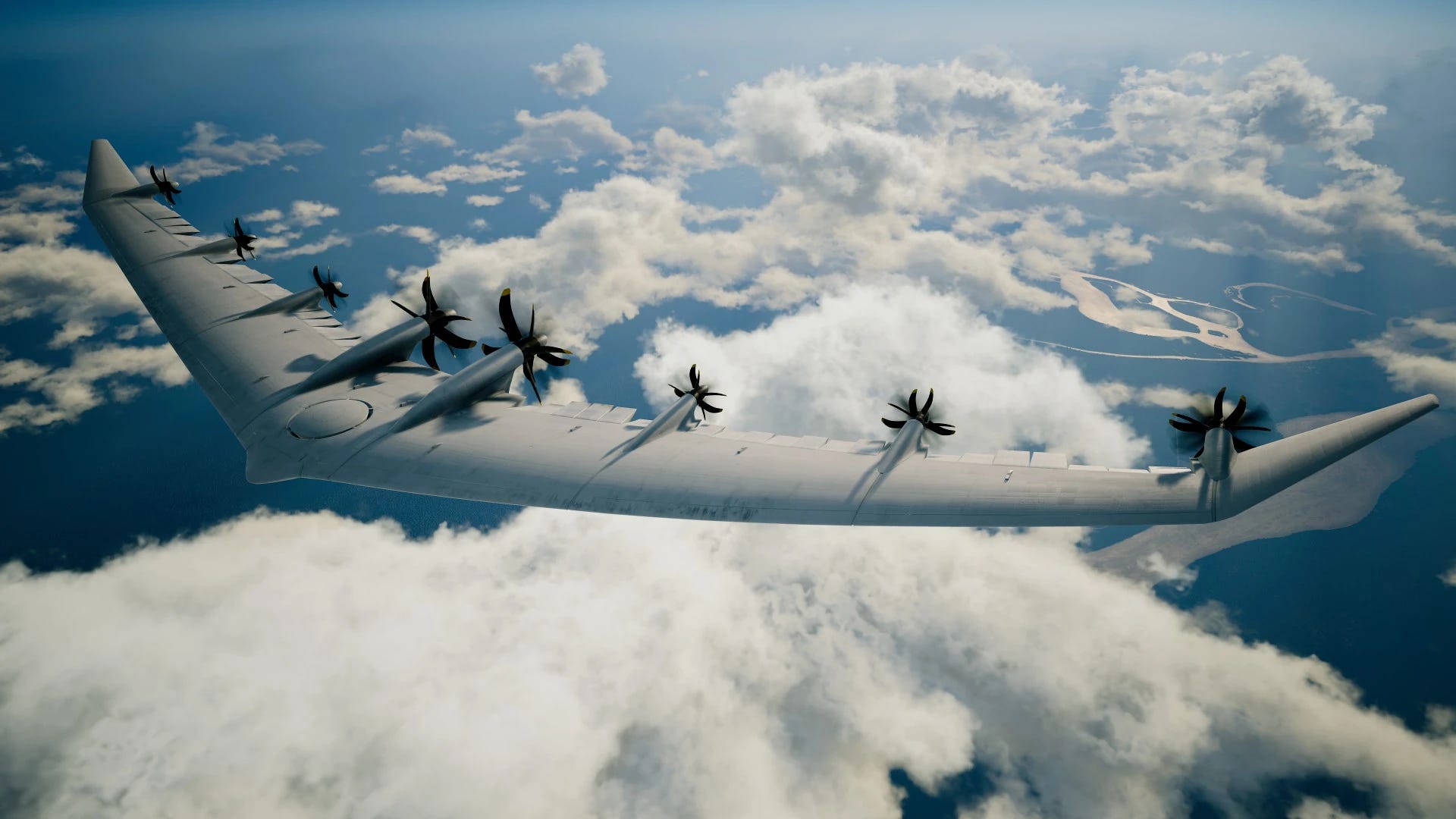
The Warbot Mothership is exactly what it sounds like: a large platform capable of deploying, arming, maintaining, and when necessary acting as a C2 element for the autonomous formation. As far as I can tell, the Chinese have the most prolific formal references to the mothership concept. (I should emphasize here the PLA does not currently possess such a system but their apparent drone carrier is undergoing sea trials.) When I first read about it in a CASI report earlier this year, a lightbulb went off for me and I’ve spent the better part of six months thinking about what the American Mothership looks like. At the time, I’d been having some related conversations with folks about how developing support networks for autonomous systems was the next step in American force design. Mothership was catchier than whatever the hell I told people. I’ve come to the conclusion that there is not one specific, exquisite American Mothership but rather a family of systems shaped by cost, simplicity, and mission to reduce the drag on warbot force design and employment. Consider the following my Rules for the Warbot Mothership:
In all domains, the mothership must reduce the need for the warbot to travel on its own to the battlefield, thereby shaping logistical and maintenance decisions in planning and system design. This likely requires an emphasis on commercial, rather military, efficiencies in design.
These motherships must be cheap, they cannot be replicants of the billion dollar oiler program the navy is currently paying for. They’re not quite expendable, but they cannot be too big to fail. They need not be autonomous themselves, but they must be crew-minimal in order to focus resources towards supporting the warbot formation. A warbot cannot change its own oil (yet).
The mothership cannot completely replace fixed support sites, but it must deemphasize them in favor of mobile support nodes. Where it cannot live on its own, it must be able to keep up with the front line force.
We cannot conduct expeditionary warfare in a sensor and warbot-saturated battlefield without motherships. Access and basing is not guaranteed, and the point of the warbot is lost if they only slow down their manned counterparts.
Segregated vs Integrated Warbot Formations
To PLA military writers, “mothership warfare” is something to aspire to as they develop their own autonomous systems; a critical operational center of gravity for autonomous force design. We have a similar concept: arsenal ships, although that concept was more focused on enabling mass fires and fell off in popularity because commanders were uncomfortable with so many exquisite platforms sitting on a single platform waiting to get rocked by a salvo of PLA missiles before it could do any good.
There’s a key difference in how the US military and the PLA think about autonomous systems: the PLA are currently emphasizing the development of wholly autonomous formations (namely aerial swarms but others are in development) while the US is focused on more heterogenous formations between manned and unmanned systems. I’ve argued before that the American approach here is correct: that manned-unmanned teaming (MUMT) is a far more effective, if more complex, use of the advantages of humans and warbots on the battlefield than segregating formations between silicon and blood.
Hosts vs Motherships
Warbots can currently ride along with manned platforms across all domains but are fairly limited in number and capability. I refer to these manned systems as “hosts” because they can only carry limited UxS and their bodies were hijacked from their original mission and purpose. Most warbots cannot return (or cannot return easily) to their hosts because the hosts were not designed for such a mission and therefore their design specs limit the designs of the warbot. The limiting factors here obviously depend upon size and mission set for both the host and the warbot and those requirements are rapidly changing as the technology matures. Motherships need to be purpose built (or retrofitted) for the mission of enabling the warbot on the battlefield. Mind you, the first American aircraft carrier (USS Langley) was built atop a retrofitted bulk carrier.
Technically speaking, an aircraft carrier is a mothership for manned systems (aircraft) and it is certainly the most mature concept we have for what one would look like in the future. We also spent decades building our force around the ability to project power via aircraft carrier, to protect those carriers, and for the carriers to enable American expeditionary warfare. By geography alone, our need to train for expeditionary conflict dictates that as we integrate the warbot into our formations, we will need to develop the platforms (motherships) necessary to support the expeditionary warbot in the future.
Spoiler: The future’s already here, it’s just not evenly distributed across the combat formation.
From Scrap, then Scratch
Today, we can start building motherships first by converting existing platforms like commercial vessels, tracked vehicles like the M113, and even legacy commercial aircraft as test beds to understand what works and what doesn’t. Using that data, we can build new platforms in parallel to be purpose-built Motherships. This will take longer, but it means we can build the Mothership to the mission(s), rather than confining the mission to the Mothership. As we are principally focused on attritable systems for the time being, this buys us time but the future approaches fast. As the selection of warbots grows and their capabilities (and sheer numbers) expand, the need for the mothership goes from optional to operational necessity rather quickly.
Warbots need Humans, too.
Of course, the warbot already exists in all domains and aircraft carriers are most efficiently designed to support manned aircraft with human enablers. So while the concept can carry over, we will need new Motherships that are purpose built for how we want to fight and how we are limited in that fight by the basic needs of man and machine: food, fuel, ammo, rest, maintenance, and medical. Developing a fully autonomous system of systems that can carry, launch, recover, and maintain the warbot is possible, but it is also going to take years (if not decades) worth of work to develop new systems, processes, and machinery to support such the tempo and operate in hazards of modern warfare. And even then, you’ll always want a human or set of humans to be there to monitor and act as a redundancy.
We need humans to take care of warbots. It’s a matter of efficiencies. Most components don’t fix themselves, and humans are designed for tinkering with the machines they build. So long as we need human maintainers and enablers, we will have to take life support systems into account and that means finding new efficiencies to reduce the tail of warbot formations. You won’t get 100% efficiency up front, and that’s ok. If the heaviest logistical burden you have for a mission is the life support for a few dozen maintainers and Class III and V for the warbot, that is light years ahead of the requirements for a 5000 person manned vessel for manned missions.
Does this means we get rid of manned motherships?
No. What did I just say about the efficiencies generated from blood and silicon? The aircraft carrier or armored vehicle isn’t going away just because we can yeet a few warbots at the enemy with minimal tail. Now instead of trying to balance the mission demands for warbot and manned systems from a singular node, you can distribute them. UGVs become force multipliers for armored formations when they’re kicked out the back of a Bradley or 113 into the breach, CCAs complicate enemy defensive measures against an air raid, and any commercial vessel becomes a potential asset to the fleet as we rebuild our shipbuilding industry. You are going to need humans for maintenance and management for a very long time, but as time goes on, you will need fewer per mission.
If it sits, the missile fits.
When a human gets wounded in combat they’re treated on site, en route, and then at higher echelons further from the front depending upon the severity of the wound and availability of care. You can’t always get the soldier bleeding from their neck back to the rear in time for the brigade surgeon and in today’s war, there’s probably two dozen others with identical wounds. Triaging warbot damage in the field so as to not bog down Mothership operations will be critical and require a new set of skills for those on the battlefield.
We’ve also taken great pains to learn how to distribute operations and basing so we don’t provide too much of a juicy target in any single location (see: Arsenal ships). This means that not only is the mothership not the sole solution to enabling warbots in combat, they will inevitably become juicy targets themselves. As such, you may very well need depot-level maintenance that demands a fixed base, but in order to not repeat the lessons of the arsenal ship, you will have to find balance between the efficiencies of large motherships and fixed bases for autonomous systems vs the harsh realities of survival on the modern battlefield through mobility and signature reduction. The need to survive long enough to get smaller warbots to the fight may very well dictate the need for smaller Motherships vs their aircraft carrier equivalents.
Conclusion
Whether you’re building one-way attack UAS, long-endurance UUVs, or unmanned breaching vehicles, maintenance comes for everyone whether they be blood or silicon. The Mothership is the missing keystone for the combined minds formation. We can and should start building Motherships today, not least because they’re going to take time to get right. Some will be rather cheap and simply, like retrofitting LMTV trucks to carry UAS launchers. Others will be more complicated as they battle the elements to refit and maintain unmanned naval systems. Just as the aircraft carrier was for the 20th century, the Warbot Mothership will become the center of power projection and expeditionary warfare for the 21st. The Mothership will get your warbot to the fight and keep you in the fight. We just have to build it.
If you would like to read more about the future of US-China conflict and warbots in combat, check out my novel, EX SUPRA. It’s all about the world after the fall of Taiwan, an isolationist and hyper-partisan America, and World War III. It was nominated for a Prometheus Award for best science fiction novel and the sequel “DUALITY” is coming out in 2026! Don’t forget to share and subscribe!